





Eye For Film >> Movies >> The River Train (2026) Film Review


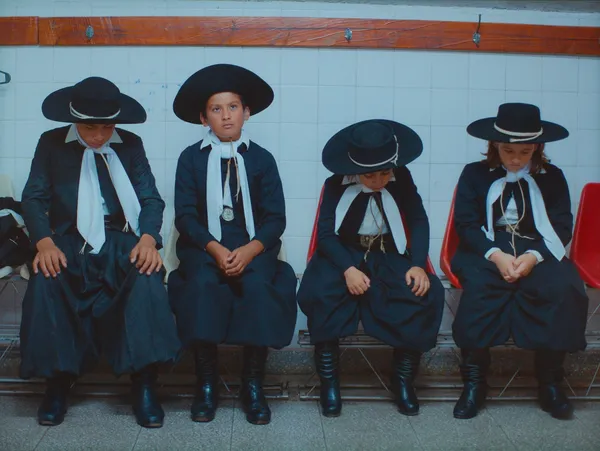

Nine-year-old Milo is hemmed in by the expectation that he become a great malambo dancer and the “perfect” son. He runs away toward Buenos Aires, then later returns with dreams the metropolis did not fulfil. Along the way, The River Train lets language do what plot will not always do, it gives a child’s abstract longings a body.
The voice that guides Milo is not only the rhythm of rails but a conductor’s PA, which twice slips into poetry. The announcements recite Francisco Madariaga, The Light Jungle (La selva liviana) and Summer Journey with Lucio (Viaje estival con Lucio), and those lines do not describe feelings so much as incarnate them. Oblivion becomes a hot brick, the landscape a sword, childhood a water whose colours can turn the northeastern wind green. That way of making the abstract physical fits Milo’s hunger for another life, one beyond washing dishes, cooking, and practising at night, and the film’s look meets it halfway, bathing the journey in a powdery pastel palette and soft, storybook light. At moments it feels like live action Miyazaki in temperament, where weather, terrain, and objects carry emotional agency.

The co-directors, Lorenzo Ferro and Lucas A Vignale, are smart about what Milo thinks he is escaping and what actually follows him onto the train. Buenos Aires exists first as an image bank, learned from movies and television, and the narrative keeps testing that borrowed picture against the city’s indifferent scale. The point is not that the capital is cruel. It is that it is busy being itself. Milo can step into it, but it does not step toward him. The result is a gentle education in solitude. Freedom is not only the absence of parents or chores; it is also the burden of choosing where to go when nobody is choosing for you.
Milo’s trip is punctuated by encounters that play like parables without insisting on a single meaning. At a rural train station, he meets a steward wearing what looks like a crown of thorns, seated beneath walls papered with children’s train drawings. They pass a soccer ball back and forth, and when the steward kicks it upward it refuses to come down, as if gravity has been politely suspended. Elsewhere, Milo finds a man asleep on the platform with headphones on, and when the boy slips the headphones over his ears the sleeper begins speaking directly to him through the audio, turning a mundane object into an oracle. The narrative flirts with magical realism, but it also invites a simpler inference. The “magic” is often just heightened perception, poetry and peculiarity treated with the same reality as timetables and rails, especially through a child’s mind.
For all its assurance, this is an audacious first feature from Argentine co-directors, both still in their late twenties, and it will not be everyone’s cup of tea. It withholds the usual consolations. There is no neat catharsis, no explanatory closure, and it is willing to stay abstract long enough to test a viewer’s patience. The better comparison is not a coming-of-age drama but The Little Prince, a fable that asks you to accept its logic before you interrogate it. In that sense, The River Train is almost a homework film. It nudges you toward reading up, looking things up, translating a line, circling back, and letting the mood settle in your body rather than turning everything into a puzzle to be solved. If you meet it on that wavelength, the film’s strangeness becomes its invitation rather than its barrier.
Reviewed on: 19 Feb 2026


Director: Lorenzo Ferro, Lucas A Vignale
Writer: Lorenzo Ferro, Lucas A Vignale
Starring: Milo Barria, Rita Pauls, Mariano Barria, Lucrecia Pazos, Mailen Barria, Diego Puente, Pehuén Pedre, Fabián Casas
Year: 2026
Runtime: 75 minutes
Country: Argentina
Search database:
